My Cart: 0 item(s)


Thumbnail Filmstrip of Behmor 2000AB Plus Home Coffee Roaster Images
About Behmor 2000AB Plus Home Coffee Roaster
We have sold thousands of Behmor roasters over the years and we have been offering them since their introduction in 2007, so we have deep experience with these roasters. In addition to what we believe is the best Behmor deal available, we hope our experience provides you with the confidence to purchase from us. The Behmor 2000AB roaster is the only home coffee roaster with built in smoke suppression.
Many of most recent changes in Behmor roaster construction are subtle improvements. This is the latest Behmor 2000AB Plus model. The "Plus" was added in the summer of 2020 and added the features shown below. Owners of the prior Behmor 2000AB can purchase an upgrade kit should they wish to convert to this latest build. There are no outward appearance differences between the Behmor 2000AB Plus and Behmor 2000AB. All of the differences relate to functionality and preparation for future features. The new and/or improved features are as follows:
- New higher multi-speed motor for better roast control, 16 and 32 RPM
- New 2x powerful micro controller (MCU) increases speed between program changes by 50%
- New On Board Audible Beep Advisory, the unattended safety shutoff with 15 seconds remaining warning
- New Universal Power Board and Control Board which adds future flexibility
- New Reprogrammed Firmware Feature (requires a wired connection) allows for future upgrades
FREE SHIPPING
IN LOWER 48 STATES (No PO Boxes)
Includes 8 one pound bags of coffee from all over the world.
The best offer available!
Plus $10 coupon on your next purchase of green coffee from Roastmasters.com ($25 min purchase pre-coupon)
Hawaii, Alaska and Canada - $20 Shipping discount applies to any method.
HI, AK use coupon code SHIPBEHM during checkout. Canada use SHIPBEHMC.
We have been offering Behmor roasters since their first day in 2007. This latest Behmor 2000AB builds upon the successful Behmor AB model, adding mostly internal changes that will allow users to upgrade their roasters more easily in future. It also added a much requested audible beep to the unattended safety feature - for safety and to make sure you were at the roaster during the latter stages of a roast, lights used to blink for thirty seconds at 75% into the roast time. To continue roasting you had to press the "Start" button, otherwise the roaster would stop heating and go into a cooldown cycle. Users requested an audible signal and the latest build brings that feature.
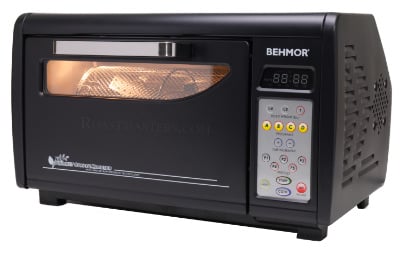 The Behmor 2000AB roasts 1/4, 1/2 or 1 pound of coffee
with a choice of five profile programs. You cannot save program changes, but some modifications can be made during a roast cycle to alter results. A terrific
roasting feature is the Behmor's smoke suppression system, which is very effective at nearly eliminating roasting smoke and much of the associated aroma. Though be aware that even with the elimination of smoke and some aroma, nothing will completely remove all of the residual aspects of coffee roasting in your home. This roaster, as the instructions will tell you, is not for doing dark roasts. The maximum roast darkness is
about 10 seconds beyond the second crack, which presents as a lightly spotted roast, a little beyond Full City, or what you might describe as a light Viennese Roast. If you wish to roast coffee darker than this you should look at our other choices in home roasters.
However, if your needs are in the realm of lighter roasts, which are best for coffee's flavor nuances, the Behmor is a real contender.
The Behmor 2000AB roasts 1/4, 1/2 or 1 pound of coffee
with a choice of five profile programs. You cannot save program changes, but some modifications can be made during a roast cycle to alter results. A terrific
roasting feature is the Behmor's smoke suppression system, which is very effective at nearly eliminating roasting smoke and much of the associated aroma. Though be aware that even with the elimination of smoke and some aroma, nothing will completely remove all of the residual aspects of coffee roasting in your home. This roaster, as the instructions will tell you, is not for doing dark roasts. The maximum roast darkness is
about 10 seconds beyond the second crack, which presents as a lightly spotted roast, a little beyond Full City, or what you might describe as a light Viennese Roast. If you wish to roast coffee darker than this you should look at our other choices in home roasters.
However, if your needs are in the realm of lighter roasts, which are best for coffee's flavor nuances, the Behmor is a real contender.
The Behmor 2000AB offers a lot of surprises and in many ways it is a wolf in sheep's clothing. Upon opening the shipping box the first impression was that the box itself was substantial. When we took the roaster out of the inner product packaging a few things stood out. Firstly, and everyone will say this,the roaster looks like a toaster oven or perhaps a microwave. We have to admit it's nicely made and it's obvious from the outset that a lot of detail and thought has gone into its finishes. The exterior, pull down door has a matte black finish facing out, with a knife shaped window a couple of inches tall and nearly the full width of the door. To the right of the door is the control panel and display.
Behmor Construction Details
Open the front door and the first thing that greets you is perforated stainless steel. Upon unpacking the roaster and reading the directions fully, you will learn that this is the chaff collector (chaff tray) and it is fabricated of stainless throughout. Coffee roasting normally produces "chaff", which is the silvery paper membrane covering most coffee. All coffee roasters have a chaff collector, as it is important to remove it while roasting. Chaff can not only change a coffee's flavor (and not in a favorable way), it can clog air intakes and become a source of ignition. Behmor has cleverly taken care of this problem with their chaff tray. The tray has a series of vanes or louvers that open when positioned inside the roaster. During roasting, the chaff that comes off the coffee is blown over and behind the louvers, trapping it. By doing so, the chance of chaff ignition is all but eliminated while airflow for the roast itself is improved; air passes through the vanes, but chaff is left behind. A 2-inch paintbrush, provided, is the "broom". This sweeps out any chaff at the end of the roast, and helps keep your roaster clean.
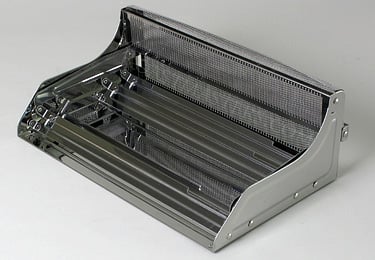
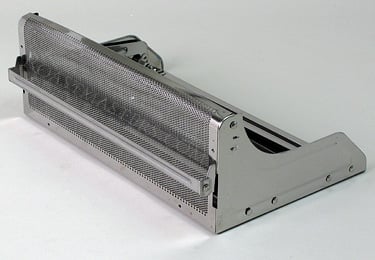
Behmor stainless chaff collector front and rear views.
Behmors were originally packed with a unwelded basketweave pattern cylinder, however customers requested one with smaller spacing for miniature or irregularly shaped beans. The so-called small grid cylinder was developed in response, and eventually became the standard issue cylinder, replacing the original in new roasters. In late December 2012 a third generation of grid was introduced, with a diagonal pattern and a simplified clasp on the end.
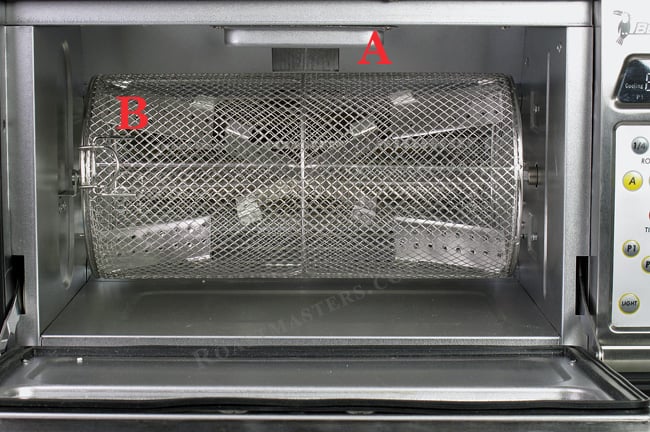
B. Behmor roasting drum
The drum, of course, turns during roasting. It can only attach to the roaster housing and its motor one way. One side of the drum has a square peg that fits into a square hole; the other side is rounded and slips into a receiving collar once the square end is in place. You are to lift up on the left side collared end and, moving the drum to the left, it should withdraw from the square hole.
With the drum out the interior is clean and surrounded by clean, aluminum coated steel surfaces. At the rear of the roaster are its heating elements, two 525-watt glass-heating elements for a total of 1050 watts, more than other home roasters. This is one reason the Behmor is capable of roasting up to a pound. At the top of the interior is heated exhaust, which is responsible for removing smoke and some roasting odor. The interior is lit and the light can be turned on after the start of a roast with a button on the control panel; the light goes out after the cooling cycle has ended unless you want to turn it off sooner.
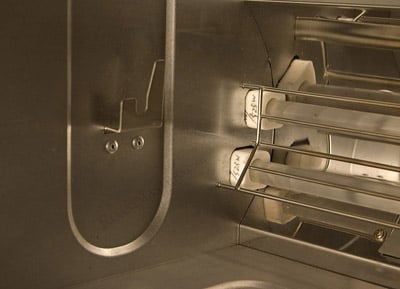
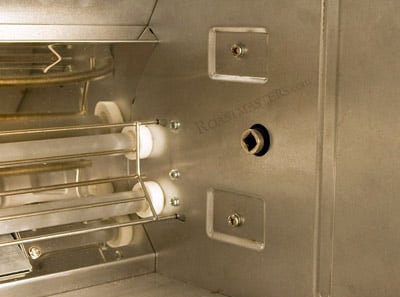
Drum fits into square hole on right and into the hook on left.
Roasting with the Behmor 2000AB
 This roaster was designed to appeal to a broad range of consumers, meaning that it had to be simple enough for anyone interested in home roasting without
full knowledge of coffee roasting technique; but it also needed to have some bells, whistles and controls for the experienced or tech-savvy enthusiast - a tall order and likely an impossible one. The Behmor AB adds optional manual controls and readouts that were missing from the previous model. Also, to increase the safety of home roasting, Behmor has added an blinking alert at 75% into the roast that verifies you are in attendance and paying attention to your roast. If you don't hit the start button within 30 seconds then the roast will end. This requires you stay by the roaster and watch its display rather than walk away and risk an issue.
This roaster was designed to appeal to a broad range of consumers, meaning that it had to be simple enough for anyone interested in home roasting without
full knowledge of coffee roasting technique; but it also needed to have some bells, whistles and controls for the experienced or tech-savvy enthusiast - a tall order and likely an impossible one. The Behmor AB adds optional manual controls and readouts that were missing from the previous model. Also, to increase the safety of home roasting, Behmor has added an blinking alert at 75% into the roast that verifies you are in attendance and paying attention to your roast. If you don't hit the start button within 30 seconds then the roast will end. This requires you stay by the roaster and watch its display rather than walk away and risk an issue.
Being a very quiet roaster it is easy to hear coffee go through first crack. Behmor has no doubt done laborious measurements to determine about how long it takes for coffee to go from first to second crack under various conditions, like bean type, weight of coffee being roasted and selected profile. In their manual they direct you to use their "Rosetta Stone", a simple guide to how long it takes for coffee to go from first to second crack based on bean weight. Taking their advice in this regard is good idea, especially for new users, even those with prior roasting experience.
The roaster's interior 15 watt light provides enough visibility to see bean development; with the low profile chaff tray you have an unobstructed view of the roast. You will get the hang of roasting on the Behmor quickly. You will also find that the profiles built in to the Behmor are very close to what you will likely seek in finished roasts and highly repeatable. This roaster's ability to repeat results is one of its strengths.
Profiles - As previously mentioned there are five pre-set roasting profiles. Joe Behm, inventor of the Behmor, is not a coffee roaster himself by trade. But he had valuable input and advice from some experienced industry insiders in developing these profiles. The instructions provided suggest which profile to use for a particular type of bean which they classify as: hard, soft or island. Further, there are specific instructions about roasting 1/4, 1/2, or 1 pound of coffee for each of the profiles. Weight of the coffee being roasted increases roast time, with full pounds reaching more than twenty minutes. This may be of concern to some, but coffee can be roasted for extended times as long as it is not baking or causing beans to chip.
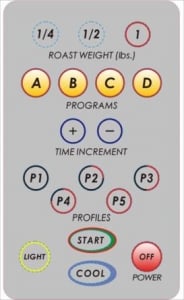
Keypad - The control panel keypad is broken into sections for:
- Roast Weight - 1/4, 1/2, or1 pound
- Programs - determine how long a profile takes to run
- Time increment - which are really time adjustments. Pressing the + button increases roast time in 15 second increments up to the maximum allowed for each profile and weight combination; the - button decreases roast time in 10 second increments.
- Profiles - variable roast methods to achieve different taste elements from any given coffee.
- Other buttons - Start,Off, Light and Cool are self-explanatory. Cool begins the cooling cycle immediately.
To do a roast, choose a profile, program, and select the appropriate weight of coffee to be roasted (1/4, 1/2, or 1 pound). For example, if you wanted to roast a half pound of hard bean Guatemala at Profile 2, you would press these buttons: 1/2, P2, B,Start. The first button selects the weight, the second the profile, the third (B) the length of time the profile runs, in this case 13 minutes, and finally, Start to begin the roast.
Shown below are the initial start times associated with each weight and program buttons. These can be further adjusted with the plus and minus time increment buttons up to the maximum allowed for each profile and weight combination.
Initial Roast Times
| 1/4 | 1/2 | 1 | |
|---|---|---|---|
| A | 8:30 | 12:00 | 18:00 |
| B | 9:30 | 13:00 | 20:00 |
| C | 10:00 | 14:00 | 21:30 |
| D | 10:30 | 15:00 | 23:00 |
Important: We observed no hot spots, tipping or chipping of the beans during any roast cycles. Beans roasted uniformly. The drum's design, which has several paddle sand vee shapes, provides for ample mixing and movement during roasting.Also of significance, coffee is not roasting in a smoky environment soothe roasted beans have a cleaner, brighter taste. Many commercial roasters cannot lay claim to this, not to mention home roasters.
Profiles Detailed
- P1 - Basically ramps right on up to 100% power and keeps that level for 100% of the roast time, producing the quickest roast. Notation: 100/100.
- P2 - Like P1 ramps at100% for the first 60% of the roasting time, then drops to 70% power for the next 30% of time. Full power for remainder of roast. Notation:100/60, 70/30, 100/10.
- P3 - A more gradual ramp-up. During the first 20% of time roasts at 70% power; 80% power during next 35% of time; full power during remainder of roast. Notation: 70/20, 80/35, 100/45.
- P4 - A variation on P3.During the first 30% of time roasts at 70% power; 85% power during next30% of time; full power during remainder of roast. Notation: 70/30,85/30, 100/40.
- P5 - The longest roast with the slowest, most gradual ramp-up. Roast time is broken into thirds with 70%, 80% and 95% power supplied in each segment respectively. Notation: 70/33, 80/33, 95/34.
Here is the logic: P1 is the hottest, fastest roast, P5 the slowest and the others are variations in between. Behmor shows P1 and P2 as roasts for Hard Bean coffees;P3 for Soft Bean/low grown coffees; P4 for soft or espresso blends;and, P5 for Island coffees such as those from Hawaii, Jamaica, etc roasted to City/City+. Our own assessment and preference differs slightly for a number of coffees we have roasted. We find ourselves gravitating to P2 and P3 for many coffees. These profiles provide brightness plus body. The P5 profile is a sharp contrast to the others in that it produces roasts that are definitely skewed toward acidity; many of the mid tones and body are missing. Nonetheless, it is informative to seethe effects on the final output.
While the roasting profiles cannot be altered or reprogrammed, it is possible to add or subtract time to roasts once they have started and effectively tweak them in this fashion. This roaster is unique in that you can continue to add increments up to the maximum allowed for each profile and weight combination (see chart below), though be cautioned, once past second crack you will begin to be inundated with smoke and this roaster has not been designed to produce dark roasts.
Maximum Roast Times - The roaster will not let you roast longer than the times shown below for each weight and profile as indicated.
Maximum Roast Times
| 1/4 | 1/2 | 1 | |
|---|---|---|---|
| P1 | 10 | 13:30 | 20:30 |
| P2 | 10:30 | 14:30 | 22:30 |
| P3 | 11 | 15:30 | 23:30 |
| P4 | 11:30 | 16:30 | 24:30 |
| P5 | 12:30 | 17:30 | 25:30 |
Conclusion
The Behmor 2000AB and prior generations of Behmors have proved to be the most popular home roasters on the market. The 2000AB model takes it to the next level adding enhancements noted at top. Roast using automatic setttings or switch to full manual. In addition readouts provide general temperatures of the exhaust channel or chamber wall. The bottom line is that it roasts coffee very well and does so with minimum of noise and smoke, making it well suited to home use. The price point puts it in reach of most consumers, filling a gap between the smaller roasters that sell for less than $300 and larger Genecafe and Hottop roasters that sell for hundreds more. Also, the flexibility to roast batches up to a full pound yet as small as quarter pound is terrific. Profiles are effective. The appearance of the roaster, though not 'roaster-like' will feel at home in kitchens or other areas of the home.
We strongly recommend that you restrict yourself to 1/4 pound roasts until you have gained real proficiency with the roaster before moving on to larger roasts. This will reduce failures and increase safety.
Behmor recommends you refer to the latest product documents. This manual provides more detail than the one packed with the roaster. Reference materials available for download:
- Behmor Operation Manual
- Other important updates - updated, Maintenance, Troubleshooting and more. Look here for the most common issues.
Important Note
The Behmor 2000AB is designed for use in 120volt - 60hz environments ONLY. This roaster will not work in countries with any voltage and/or frequency differences with or without a power converter. Manufacturer's warranty is void outside of North America for roasters originating in the USA.
Regarding Older Behmor Models
HOW TO UPGRADE FROM EARLIER MODELS
Behmor now offers two kits to upgrade any prior model roaster to the latest build.
- 2 piece kit for upgrading a Behmor AB. Contains a new modified power board and new more powerful MCU (micro controller unit) - $94.50
- 3 piece kit for upgrading a Behmor 1600 or Behmor 1600 Plus. Contains the two parts above as well as new 16/32 RPM switchable motor - $129.00
BEHMOR MODEL HISTORY
In the model history of Behmor roasters, the Behmor AB replaced the 1600 Plus in April/May 2019, the first model change since September 2014. The initials AB stand for the new All Black finish. The prior functionality of the Behmor 1600 Plus continues as before, allowing home roasters to switch between automatic profiles and new manual settings, but users are now able to read thermistor and exhaust temperatures. Still available is the ability to switch between drum speeds during a roast, however speed has doubled from 8 and 16 rpm to 16 and 32 rpm for increased control. The "Plus" control panel, added in 2014 and previously an optional upgrade to older models, continues to be a standard with the AB. Within the past couple of years there have also been improvements to the chaff tray, a fan was added to the side panel and the roasting grid itself was simplified with an easy clasp and welds made at each intersection so that gaps cannot develop.
Build History:
- 2007 Behmor 1600
- 2014 Behmor 1600 Plus
- 2019 Behmor AB
- 2020 Behmor 2000AB
